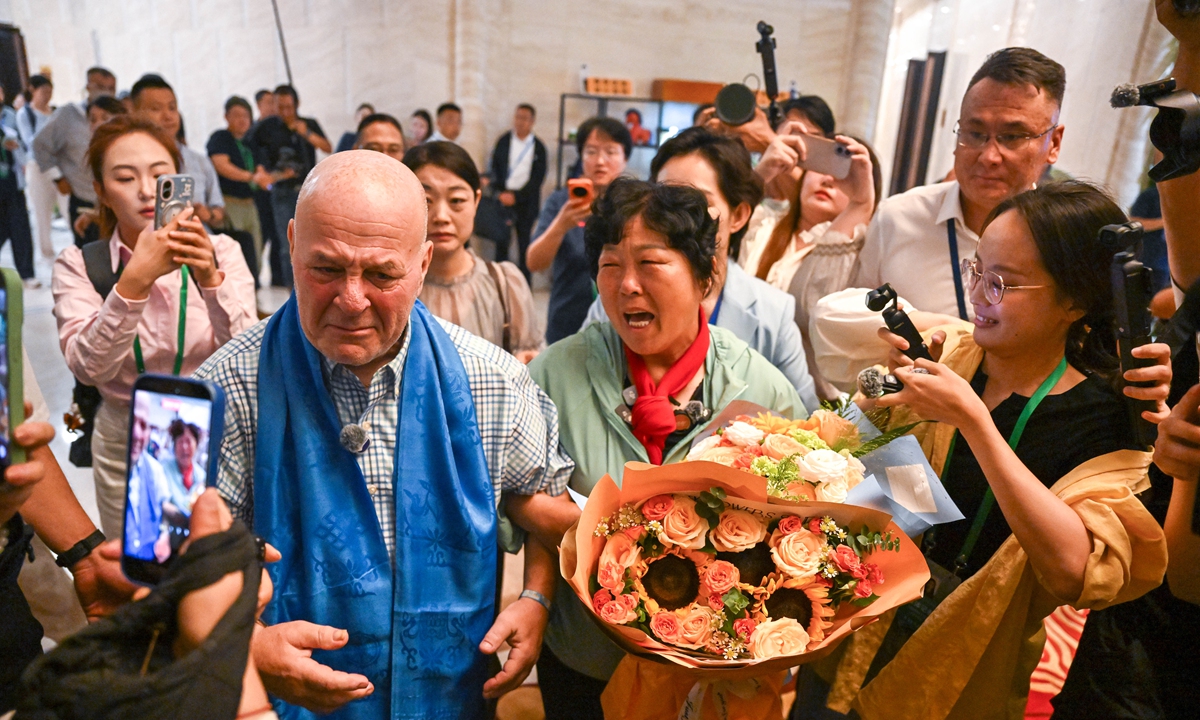
American teacher Ronald Sakolsky reunites with desert fighter Yin Yuzhen at an airport in Ordos, North China's Inner Mongolia Autonomous Region on August 23, 2026. Photo: Xinhua
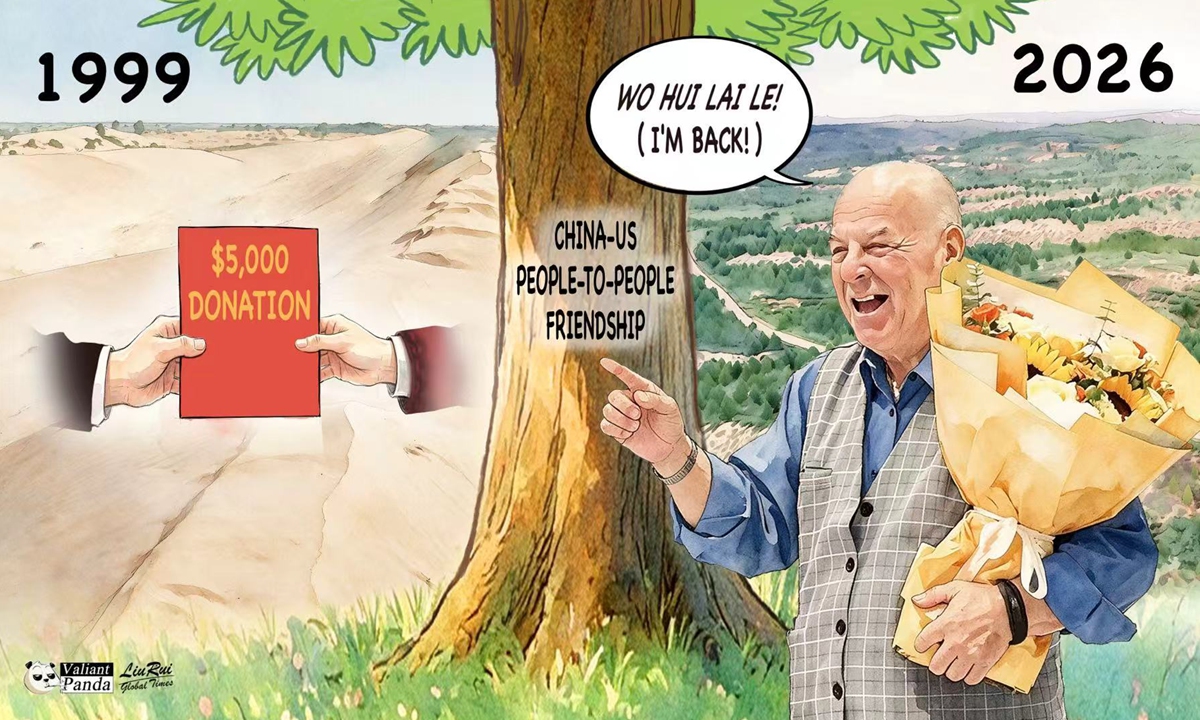
A long-awaited reunion that captured wide public attention unfolded on Sunday evening when American teacher Ronald Sakolsky and Yin Yuzhen, a model worker renowned for planting trees and combating desertification, reunited and embraced tearfully with overwhelming emotion at an airport in Ordos, North China's Inner Mongolia Autonomous Region, after 27 years of separation across the ocean. The reunion began with a single act of generosity in 1999. When Sakolsky arrived in China as a participant in a China-US education exchange program, he was moved by Yin and her husband's tireless efforts to curb desertification in the Mu Us Desert in Inner Mongolia. He raised $5,000 to fund their local tree-planting initiative. The young saplings they bought with the donation have since matured into more than 50,000 full-grown trees, transforming the once desolate, sandy wasteland into a thriving green landscape. This hug, transcending time and distance, marked not only friendship between the two countries, but also showcased the sincerity of Chinese people and a green miracle made possible through continuous joint efforts.
Seeds of China-US friendship sown long ago, now stand as towering woods. Illustration: Liu Rui/GT
Hug across 27 years At 2:48 am on early Sunday morning, Ronald Sakolsky arrived at Beijing Capital International Airport after over 10 hours of flight. As he stepped into the arrivals hall, he greeted the waiting reporters with earnest Putonghua "Wo hui lai le," meaning "I'm back." "When I saw the lights in Beijing as we were landing is when I realized that I am back in my second home." Asked what he is most looking forward to about this journey, Sakolsky told the Global Times that "I want to see Ms Yin, see the forests, see the students I have not seen for almost 30 years, my colleagues. I want to see the Chinese people." He then flew to Ordos for the meeting with his desert reclamation partner. Yin waited at the arrival gate at the airport in Ordos very early, murmuring English sentence she particularly learned for this occasion - "Welcome to China, my brother." Her eyes were fixed on the escalator and she wiped away her tears multiple times during the wait, the Global Times reporter observed. Sakolsky said in earlier interview with the Global Times that he was looking forward to this reunion and could not hold his tears back when he thought of the moment. He was about to give Yin a hug when they meet. When Sakolsky finally appeared in front of Yin, their eyes welled up. Stepping off the elevator, Sakolsky could barely contain his excitement, muttering "Oh my God, oh my God." They hurried toward each other and locked in a tight embrace at last - the long-awaited hug 27 years in the making. "This is a dream come true, from a lady who is the hero of the story, not me," Sakolsky told the Global Times at the airport, barely holding his emotion. "She made a promise 27 years ago, and she kept her promise." Talking about his donation almost three decades ago, Sakolsky said the purpose was to help her, "because she was beautifying the motherland." Now, in response to an invitation to return to China for a trip to see the green planting from his donation and to returning to the city of Luoyang, Central China's Henan Province, where he taught in the exchange program for several years, Sakolsky noted that "China had done so much for me that I wanted to say thank you to China." A return of kindness For this reunion after 27 years, Yin had carefully prepared. Steamed buns, meaning "upward," fresh vegetables and fruits picked in the land transformed from desert. Yin, never familiar with any foreign language, learned some English phrases, including "welcome to China" she practiced, "my brother" to greet Sakolsky, and "more, more" to persuade the American friend to eat more. On Sunday, Yin did her hair and wore a red scarf alongside an outfit with a green shade, which she picked particularly for the reunion, as "green is the color of the Earth," as she told the Global Times. Yin is not the only old friend that was looking forward to the reunion. While Sakolsky was still on his over-10-hour flight from the US to Beijing, Bai Fan was also on the way - driving over 850 kilometers from Luoyang to Inner Mongolia. The journey would take a day and a half. Bai was the vice principal of Luoyang Foreign Language School, overseeing international affairs. Sakolsky was an exchange teacher there through a China-US program, and was Bai's "neighbor right across the hall." Why drive such a distance? Bai had prepared special cultural gifts - peony porcelain and Hanguan Kiln purple clay tea ware, distinctive local handicrafts that proved too bulky and fragile for air travel or high-speed rail. Bai recalled Sakolsky's continuous interest in Chinese culture, and sending a replica of Terracotta Warriors to the US at Sakolsky's request. "I hope he can take these Luoyang elements and Chinese symbols to the world," Bai told the Global Times in a phone interview on Sunday. Bai is also eager to see Sakolsky at a place that they had traveled together 27 years ago. When Sakolsky came to Luoyang for the exchange program, Bai was his designated liaison. Together, they traveled to the heart of the Mu Us Desert to deliver the $5,000 donation. Bai still vividly remembers the desolate desert back then, where finger-thin saplings were watered ladle by ladle by Yin. At that time, Sakolsky had constant concerns about whether the tiny saplings could survive in the wasteland, which makes today's sprawling 50,000-tree forest even more miraculous. The changed and unchanged Things have changed over the past 27 years. While waiting for Sakolsky, Yin jokingly said he got less hair, and she would not be able to recognize him if running up to him on street. The passage of time has brought far more than personal aging, according to Bai, another witness to the decades-long changes. "Everyone is growing older. Our families have expanded with more children, local communities have grown in population, and the surrounding environment is constantly evolving, just as our cities are undergoing profound transformations." On a night tour in Ordos on Sunday, Sakolsky, watching a fountain light show, said that "it is a 21st century city, but it looks like a 22nd century city. In the 2000s, Chinese government made a promise to Chinese people to beatify this country, and they succeeded." For Sakolsky, probably the most profound transformation lies in the depth of his human connection forged. "27 years ago, we were just friends and acquaintances. We are brother and sister now. So much has happened since then, but the important thing is many people have seen the story and now they can also help to make China beautiful," he told the reporters. Through joint efforts of people like Yin, the Mu Us Desert has turned from wasteland into a green oasis. China has contributed about 25 percent of the world's newly added green areas and taken the lead in achieving zero growth in land degradation, per official data. Meanwhile, there are things unchanged, including a vintage photo of the three standing in the desert that has decorated Bai's office through all these years - a permanent reminder of their original aspiration. This reunion will witness them retake the classic photo and plant new saplings together, expanding their green mission. 。
近日,有市民反映,已运营21年的济南柏宁水族宠物用品交易广场或将于10月底闭市。 这座陪伴泉城市民21年的老牌水族地标,如今正站在去留的十字路口。商户们在去与留的焦灼中寻找退路,管理方回应“尚在商榷”。 管理方:合同10月底到期,去留仍存变数
“大约20多天前,我们突然得知了市场要关闭的消息。”经营水族店铺二十余年的王先生告诉记者。 8月23日下午,正值周末,市场内客流稀少,多处店面大门紧锁,卷帘门上贴着“招租”启事。据粗略统计,广场一、二层共设商铺69家,目前已有33家处于关门歇业状态。
记者以商户身份致电“招租”广告上的电话,工作人员表示:“租的话只能租到10月份。
B | ”问及具体原因,对方直言:“有规划。”
8月24日,记者就广场是否关停一事再次向管理方核实,对方回应称:“目前还没完全确定。10月31日是合同到期日,如果没有变动,我们会延续经营,但延续时间尚不确定。” 近半店面已歇业,老商户面临搬迁难题
王先生的店铺面积达106平方米,两年前刚花重金重新装修过。“周边基本都是二十年的老街坊,以前极少有退租更替的。”
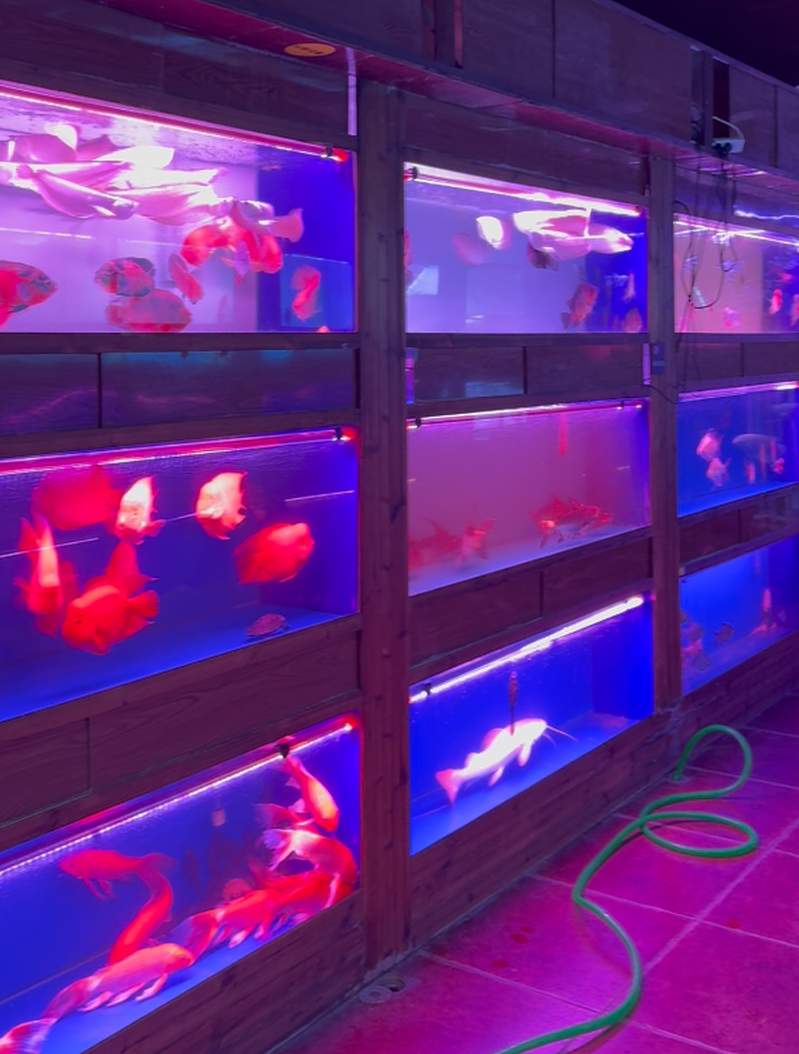
谈及经营现状,王先生叹了口气,坦言如今的营业额已断崖式跌至巅峰期的十分之一甚至二十分之一,“今天一整天营业额只有276元,算上房租和水电,连成本都保不住。”店内近百个鱼缸的供氧、加温设备需要24小时不间断运转,高昂的固定开销让当下的坚守愈发艰难。
“以前周边摆地摊的小商贩都会来这儿批发,后来渠道变了,零散客流也越来越少。”同样在此坚守了二十多年的聂女士,眼下则面临着更加繁重的善后工作。 水族行业搬迁不同于普通零售,“大大小小的重型鱼缸怎么挪、活体水族怎么安全转运、新址水电线路怎么重新布设,都是难题。还没完全想好去哪,家里人今天下午已经先出去看新铺面了。”
真正让聂女士们犹豫的,不只是搬不动的鱼缸,更是这里二十多年攒下的人情和旧时光。
C | 情怀难舍:鱼影里藏着济南人的旧时光
聂女士说,做水族这行,换了地方最怕老主顾断了线。在这座临湖而建的市场里,鱼游了二十余年,人也聚了二十余载。 泉城人爱水,也爱水里的生灵。不少老济南人的童年记忆里,都有一只圆玻璃鱼缸。
D | 透过略带畸变的弧面玻璃,一尾红尾巴轻轻一摆,就是整个夏天的欢愉。 龙睛、红虎头、大水泡,当年大明湖西南门早市上的瓦盆里,游着最地道的市井烟火。相中了哪一条,摊主用细篾小网轻轻一抄,一两块钱,便能把这份“水灵”兜回家中。 自2005年底开业以来,柏宁水族广场便成了这份市井雅趣的延续地。 在市场一角,养鱼十余年的市民孙先生正在挑选水草。
E | 他家里养着几尾飘逸的“蝴蝶蓝”,上周刚买了一株造景水草,今天特意再来配个新色。“摆在缸里对称、好看,现在市场里不少店在打折,能捡个漏。”
“二十多年的老市场了,关停了怪可惜的。”谈及市场可能关停,孙先生又补了一句:“要是真搬了也没事,我都留着老板电话呢,到时候跟着地址找过去就是了。”
只是对商户们来说,搬家不只是搬鱼缸,更是搬动一条条靠年月攒起来的老主顾关系。无论最终迁往何方,这份浸润泉城岁月的市井人情,仍希望不会轻易断线。
Current article:http://zjx.nenyaogecebenliexi.shop/list_j2pl/ibb4tz.html



 记者以商户身份致电“招租”广告上的电话,工作人员表示:“租的话只能租到10月份。
 “以前周边摆地摊的小商贩都会来这儿批发,后来渠道变了,零散客流也越来越少。”同样在此坚守了二十多年的聂女士,眼下则面临着更加繁重的善后工作。 水族行业搬迁不同于普通零售,“大大小小的重型鱼缸怎么挪、活体水族怎么安全转运、新址水电线路怎么重新布设,都是难题。还没完全想好去哪,家里人今天下午已经先出去看新铺面了。”
真正让聂女士们犹豫的,不只是搬不动的鱼缸,更是这里二十多年攒下的人情和旧时光。
“以前周边摆地摊的小商贩都会来这儿批发,后来渠道变了,零散客流也越来越少。”同样在此坚守了二十多年的聂女士,眼下则面临着更加繁重的善后工作。 水族行业搬迁不同于普通零售,“大大小小的重型鱼缸怎么挪、活体水族怎么安全转运、新址水电线路怎么重新布设,都是难题。还没完全想好去哪,家里人今天下午已经先出去看新铺面了。”
真正让聂女士们犹豫的,不只是搬不动的鱼缸,更是这里二十多年攒下的人情和旧时光。


